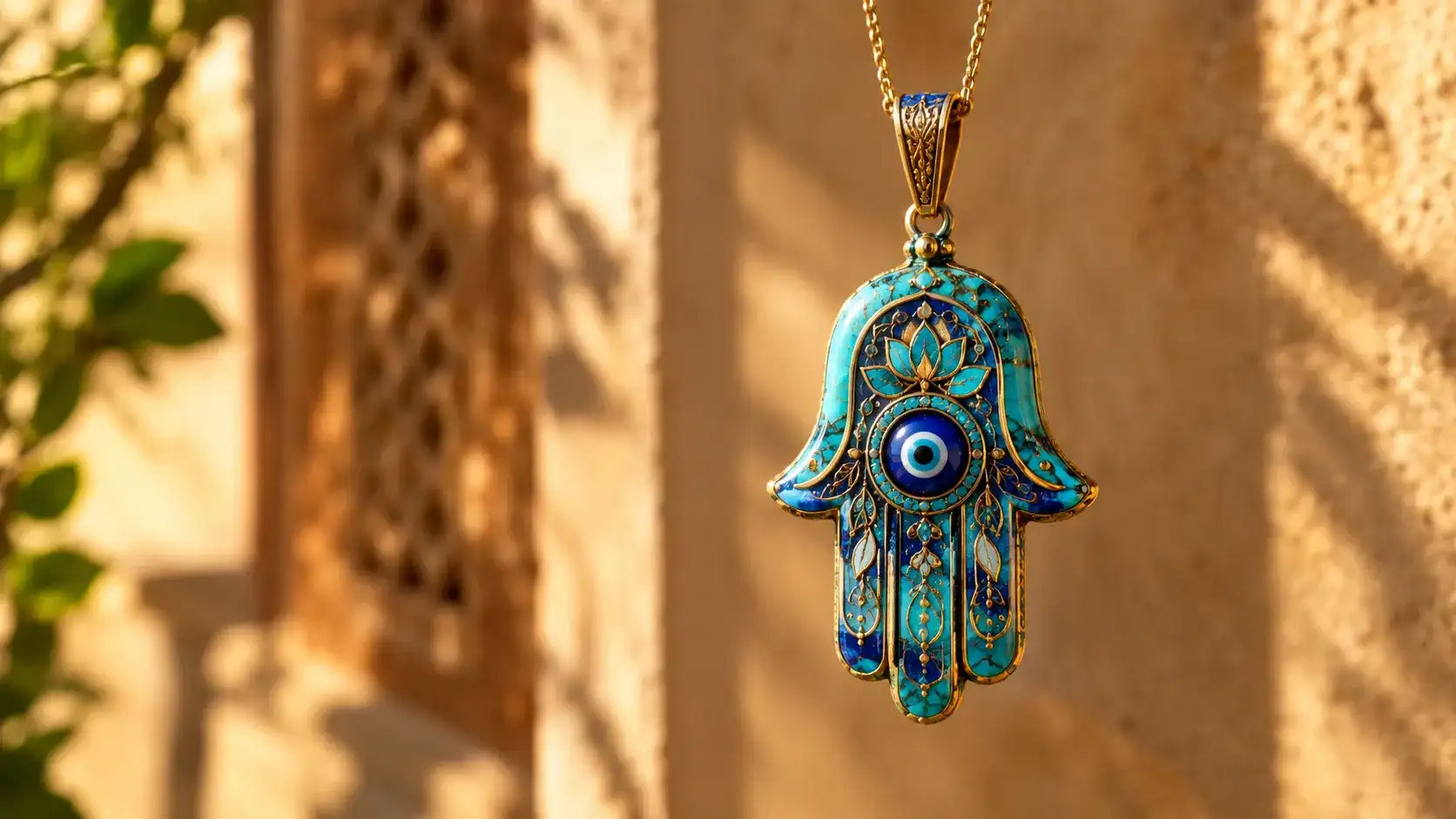
What Is the Hamsa Meaning? The Complete Symbol Guide
Written by a jewelry and symbolism researcher with 8 years of experience studying protective amulets across Middle Eastern, Jewish, and Islamic traditions. Sources cross-checked with the Union for Reform Judaism, Wikipedia’s citation record, and Unicode Consortium documentation.
You bought a hamsa pendant, or a friend gave you one, and now you want to know what it actually stands for before you wear it. Search results give you five different answers, and half of them contradict each other. That confusion ends here. This guide breaks down the real hamsa meaning, its religious roots, its color codes, and how to use it correctly.
Quick Answer: Hamsa Meaning in One Sentence
The hamsa meaning centers on protection. It is a palm-shaped amulet with five fingers, often featuring an eye in the center, worn or displayed to guard against negative energy, jealousy, and the evil eye while inviting good fortune, health, and blessings.
The Hamsa Meaning: Breaking Down the Symbol
The word “hamsa” comes from the Arabic root “khamsa,” meaning five. Hebrew uses the near-identical word “hamesh,” also meaning five. Both languages point to the same detail: five fingers spread open on a single palm.
That number is not decorative. Five carries weight in every tradition that adopted the hamsa:
- Five books of the Torah in Judaism
- Five Pillars of Islam for Sunni Muslims
- Five human senses, a reminder to stay aware and grateful
- Five members of the Prophet’s household, honored by Shia Muslims
Once you understand the number five, the hamsa meaning stops feeling mysterious and starts feeling logical. It is a hand built to remind the wearer of core spiritual duties while shielding them from harm.
Where the Hamsa Symbol Actually Comes From
Most people assume the hamsa belongs to one religion. It does not. Open-hand amulets appear in the archaeological record of Mesopotamia and North Africa long before Judaism or Islam existed as organized faiths.
Ancient traders linked the raised hand to protective goddesses such as Ishtar and Tanit, figures associated with fertility and guardianship. Researchers have traced early hand-shaped amulets back to Mesopotamia and Babylon, where they represented the hand of Ishtar and were placed at entryways to keep evil and disease out of a home.[1] Berber communities in North Africa carried a related hand symbol called “afus,” and the design later traveled into Islamic Spain through trade and migration.
By the time Jewish and Muslim communities settled across North Africa and the Middle East, the hand shape had already earned a reputation as a shield against misfortune. Each faith then layered its own story on top of a much older symbol.
Hamsa Meaning in Judaism: The Hand of Miriam
In Jewish tradition, the hamsa carries the nickname “Hand of Miriam,” named for Moses and Aaron’s sister. Miriam is remembered as a prophetess who protected her infant brother and led the Israelite women in song after crossing the Red Sea.
Jewish communities in Arab countries have historically worn this amulet to ward off evil forces, particularly the evil eye, and many Jews view it as a representation of the hand of God.[2] The five fingers double as a memory aid for the Torah’s five books: Genesis, Exodus, Leviticus, Numbers, and Deuteronomy.
You will also find the hamsa in Kabbalistic manuscripts, where its shape overlaps with the Hebrew letter “Shin,” the first letter of one of God’s names. That connection gives the symbol a second layer of meaning beyond simple protection: it becomes a quiet nod to divine presence.
Hamsa Meaning in Islam: The Hand of Fatima
Muslim communities call the same symbol the “Hand of Fatima,” honoring Fatima Zahra, daughter of the Prophet Muhammad. Fatima is remembered for her patience, generosity, and unwavering faith through personal hardship, and Muslims use the amulet the same way Jewish communities do: as protection against the evil eye and other harmful forces.[2]
For Sunni Muslims, the five fingers stand for the Five Pillars: declaration of faith, prayer, charity, fasting, and pilgrimage. Shia Muslims often connect the same five fingers to the Ahl al-Bayt, the Prophet’s closest family members.
A popular folk story explains the eye that often sits in the palm’s center. Fatima, startled by unexpected news while cooking, kept stirring a hot pot with her bare hand without feeling the pain. The eye later added to the design is said to represent that moment of quiet strength under pressure.
Hamsa in Other Faiths and Cultures
The hamsa meaning did not stay locked inside Judaism and Islam. Christian communities in parts of the Mediterranean adopted a version called the “Hand of Mary,” tying the same protective idea to the mother of Jesus. Some Hindu and Buddhist practitioners in diaspora communities have also embraced open-hand imagery, connecting it to abundance and calm.
This cross-cultural spread explains why you can walk into a jewelry shop in Tel Aviv, Marrakech, or Los Angeles and find the same shape sold as a universal good-luck charm rather than a symbol tied to one belief system.
Hamsa Hand Up or Down: Does Direction Change the Meaning?
Yes, the direction matters to some wearers, though both orientations remain common today.
- Fingers pointing down: Traditionally linked to Jewish practice, symbolizing blessings and abundance flowing downward toward the wearer.
- Fingers pointing up: Traditionally linked to Islamic practice, symbolizing a raised hand that actively blocks negative energy before it reaches you.
Modern jewelry designers rarely follow this rule strictly. Most people today choose orientation based on personal preference or how the piece sits comfortably around the neck rather than religious observance.
Hamsa and the Evil Eye: How the Two Symbols Work Together
The evil eye, called “ayin ha’ra” in Hebrew and “nazar” in Turkish and Arabic, refers to a harmful glance believed to cause misfortune through jealousy or envy. The hamsa and the evil eye frequently appear together because they solve the same problem from two angles.
The hamsa acts as a shield. The eye placed inside its palm acts as a watchful guardian, staring back at harmful intentions before they can take hold. This pairing is why so many pendants show a blue or turquoise eye set directly into the center of the hand.
Hamsa Color Meanings: A Complete Breakdown
Color changes how a hamsa is read, even though the shape stays identical. Use this table as a quick reference before you buy or gift one.
| Color | Common Meaning | Best Worn For |
| Blue | Protection, calm, deflecting the evil eye | Everyday wear, gifts for new babies |
| Turquoise | Healing, clarity, emotional balance | Stress relief, travel safety |
| Gold | Prosperity, success, confidence | Career milestones, business openings |
| Silver | Purity, clarity of intention | Spiritual practice, meditation |
| Red | Courage, passion, vitality | Motivation, overcoming fear |
| White | Peace, new beginnings, cleansing | Weddings, moving into a new home |
| Green | Growth, fertility, renewal | Pregnancy, starting a family |
| Black | Grounding, absorbing negative energy | Protection during difficult periods |
A blue hamsa remains the most widely sold version worldwide, largely because blue is the traditional color associated with warding off the evil eye across Mediterranean and Middle Eastern cultures.
Hamsa Necklace Meaning
A hamsa necklace sits closest to the heart, which is why so many people choose it as their first piece. Wearing the symbol at chest height is thought to keep protection near your emotional center throughout the day.
Many buyers pick a hamsa necklace to mark a fresh start: a new job, a move, recovery from illness, or the birth of a child. The pendant becomes a daily physical reminder to stay grounded and guarded against outside negativity.
Hamsa Bracelet Meaning
A hamsa bracelet works the same way but places the symbol on the hand or wrist, the part of the body most active in daily life. Wearers often describe the bracelet as a hands-on reminder to act with intention and avoid spreading negativity to others.
Because bracelets sit in plain sight, they also function as conversation starters, giving the wearer a natural opening to share the symbol’s history with people who ask about it.
Hamsa Tattoo Meaning
A hamsa tattoo makes the protection permanent rather than removable. People choose this design after overcoming a hard chapter, such as illness, loss, or a major life transition, and want a lasting marker of resilience.
Placement carries its own weight for many wearers:
- Wrist or forearm: A visible daily reminder of strength
- Back or shoulder: A private symbol carried close but not constantly seen
- Ankle or foot: Associated with grounding and staying connected to one’s path
Before booking a tattoo appointment, research the artist’s experience with fine linework, since the hamsa’s symmetry and detail require a steady, practiced hand.
How to Use a Hamsa for Protection at Home
Beyond jewelry, many households hang a hamsa near an entryway, kitchen, or nursery. Here is how to use one with intention rather than just decoration:
- Place it at eye level near your front door so it “greets” visitors and filters negative energy before it enters.
- Choose a color that matches your goal using the table above.
- Clean the piece occasionally with a soft cloth; some traditions treat this as a small ritual of renewal.
- Avoid stacking too many protective symbols in one room, which can clutter the intention rather than strengthen it.
- Gift a hamsa rather than buy one for yourself if you want to follow older folk customs, since a gifted hamsa is considered to carry stronger protective energy.
Common Mistakes and Myths About the Hamsa
A few misconceptions follow this symbol everywhere it travels:
- Myth: The hamsa belongs to only one religion. Reality: it predates Judaism and Islam and now appears across multiple faiths and secular fashion.
- Myth: Wearing it upside down brings bad luck. Reality: orientation is a cultural preference, not a strict rule with consequences.
- Myth: Any hand-shaped charm counts as a hamsa. Reality: the true symbol always shows five fingers spread evenly, often but not always with an eye in the palm.
- Myth: The hamsa and the “OK” hand gesture are related. Reality: they share no historical or symbolic connection.
Clearing up these myths protects the integrity of a symbol that still carries real religious weight for millions of people.
Hamsa Meaning Today: From Ancient Amulet to Global Icon
The hamsa gained official recognition as a Unicode emoji in 2021, appearing as a blue hand with an eye at its center and representing luck, protection, guidance, and faith across several religious traditions.[3] That recognition confirms what jewelry sales already showed: the hamsa has moved from a regional religious amulet into a globally recognized symbol of protection.
Fashion brands, home decor lines, and tattoo studios now treat the hamsa meaning as shorthand for positivity and safety, stripped of any single religious claim. For many wearers today, the appeal sits in that shared meaning: a symbol that welcomes people of different backgrounds under one protective idea.
FAQs
What does hamsa mean in English?
Hamsa translates directly to “five,” referring to the five fingers of the open hand. In practice, the word describes both the number and the protective amulet shaped like a hand.
Is the hamsa a religious symbol or just fashion jewelry?
It started as a religious and cultural amulet in Judaism and Islam, but it has grown into a widely worn fashion piece. Both uses are valid, though wearing it with awareness of its history shows more respect for the communities that originated it.
Can anyone wear a hamsa, regardless of religion?
Yes. The hamsa is not restricted to one faith, and people from many backgrounds wear it as a symbol of protection and good fortune. Understanding its roots simply adds depth to the choice.
What is the difference between a hamsa and an evil eye charm?
A hamsa is the hand-shaped amulet itself, while the evil eye is a separate protective symbol, usually a blue eye-shaped bead. Designers frequently combine both by placing an evil eye in the center of the hamsa’s palm.
Does the hamsa need to face up or down?
No fixed rule applies today. Traditionally, downward fingers link to Jewish custom and upward fingers link to Islamic custom, but modern wearers choose either direction freely.
What is the best hamsa color for protection?
Blue is the most traditional choice for protection against the evil eye, though turquoise and silver are also popular for calming and clarifying energy. Choose based on the intention listed in the color table above.
Final Thoughts on Hamsa Meaning
The hamsa meaning has survived thousands of years because it answers a need every culture shares: a wish for protection, blessings, and a steady hand through hard days. Whether you wear it as a necklace, a bracelet, or ink it permanently on your skin, you are carrying a symbol with real history behind it.
Choose your hamsa with intention. Pick a color that matches your goal, learn the story behind the design, and share that history with anyone who asks. If you found this guide helpful, pass it along to a friend who just picked up their first hamsa piece and wants to understand what it truly represents.